
What Season Is May in China? Calendar and Regional Context
May is meteorological spring in China, but local weather ranges from cool northern conditions to…
Read More →Cold Dew should not be presented as one nationwide food or ritual day. This guide distinguishes the calendar marker from dated regional autumn work, including apple harvesting in Gansu and corn harvesting in Shandong; those observations do not prove a shared festival custom.
Cold Dew, Hanlu (寒露), marks an autumn calendar point after the Autumn Equinox and before Frost Descent. In 2026 it falls on October 8 in Hong Kong Time (UTC+8), at a solar longitude of 195°.

Cold Dew is Hanlu, not Shuangjiang. The dew in its name should not be equated with frost or treated as proof that a location has entered freezing weather.
| Chinese name | Hanlu (寒露) |
|---|---|
| Solar longitude | 195° |
| 2026 date | October 8, Hong Kong Time (UTC+8) |
| Adjacent terms | Autumn Equinox → Cold Dew → Frost Descent |
Xinhua photographs published by the State Council portal document different work on October 8, 2022: apple picking in Pingliang, Gansu; corn harvesting in Liaocheng, Shandong; and strawberry planting in Dazhou, Sichuan.
The seasonal word “autumn” here follows the traditional Northern Hemisphere calendar. The Hong Kong Observatory relates many term names to ancient central Chinese weather and agriculture. Local weather and plant development may differ; Southern Hemisphere seasonal timing is reversed.
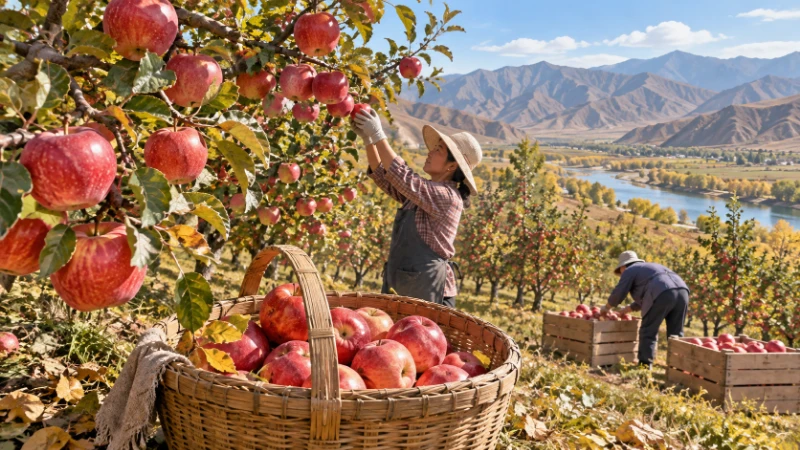
These are dated agricultural observations, not a shared festival ritual or a planting instruction for every year.
Regional example source: read the named account. The account supports the place and practice stated above, not medical benefits or a national rule.
Hong Kong Observatory: term names and solar longitudes; 2026 Gregorian–lunar conversion table; date and time notes (Hong Kong Time, UTC+8). The calendar sources establish astronomical timing and terminology; they do not verify regional customs.
October 8 in Hong Kong Time (UTC+8). The solar-term boundary is at 195° solar longitude; civil dates in other timezones can differ.
No. Customs require place-specific sources and vary between communities and households. The astronomical calendar does not establish a national food or ritual rule.
May is meteorological spring in China, but local weather ranges from cool northern conditions to…
Read More →
Understand winter in China by month and region, from snowy northeast cities to mild southern…
Read More →
China has no single monsoon month. Compare South China, the Yangtze Meiyu belt, North China,…
Read More →