Quick answer
On October 14, 2026, China is in autumn under both the standard Northern Hemisphere meteorological calendar and the astronomical calendar. In the traditional sequence of the 24 solar terms, the date falls after Cold Dew (寒露, Hánlù) and before Frost’s Descent (霜降, Shuāngjiàng).
That answer describes the calendar, not identical weather across the country. China spans subtropical coasts, temperate plains, deserts, mountains, and high plateaus. On the same date, northern cities may feel distinctly autumnal, parts of the far south may remain warm and green, and high-altitude areas may already experience winterlike conditions.
Three ways to answer the season question

| System | Autumn in China | Best use | Main limitation |
|---|---|---|---|
| Meteorological seasons | September, October, November | Climate summaries and month-based comparison | Does not describe every local day's weather |
| Astronomical seasons | September equinox to December solstice | Earth's orbit, equinoxes, and solstices | Boundary times vary slightly by year and time zone |
| Traditional 24 solar terms | Autumn sequence from Beginning of Autumn through Frost's Descent | Chinese calendar, farming knowledge, seasonal culture | Traditional observations originated in the Yellow River region and do not map uniformly to all climates |
The Hong Kong Observatory’s definition of seasons uses September through November for meteorological autumn in the Northern Hemisphere. It also explains that temperature-, rainfall-, or monsoon-based season definitions can have different start dates and may not transfer directly from one region to another.
The short answer for October 14, 2026

For a simple date-based answer, October 14 is autumn. This works for school calendars, general travel planning, and comparisons with other Northern Hemisphere countries. It also sits in the autumn group of the 24 solar terms.
For clothing or outdoor plans, the city matters more than the national label:
- Northeast and far north: cooling advances earlier; late autumn can arrive quickly, and frost or early snow is possible in some places.
- North China Plain: October often has a clearer autumn character, but day-night temperature ranges can be large.
- Lower Yangtze and central-east: autumn may be milder, and the transition from summer heat can vary from year to year.
- South China coast: subtropical warmth can continue even while the calendar says autumn; tropical cyclones and monsoon conditions can still matter.
- Southwest highlands and western plateaus: elevation can produce cold nights or snow far earlier than latitude alone suggests.
These are regional patterns, not a forecast for a specific trip. Check a current local forecast close to the travel date.
Why one country can feel like several seasons
Latitude is only one control. Elevation, distance from the sea, topography, and monsoon circulation all affect temperature and rainfall. A high plateau can be cold when a southern lowland is still warm. A coastal city can remain humid while an inland region becomes dry.
The Hong Kong Observatory describes Hong Kong as subtropical and notes that its seasonal experience differs across the year: summer is hot and humid, while November and December are often drier and more comfortable. That local description should not be copied onto Beijing, Harbin, Kunming, Lhasa, or Urumqi. The practical rule is to pair a national season label with the climate of the actual destination.
China also has a current national standard, GB/T 42074-2022, Division of Climatic Seasons, under the China Meteorological Administration. Its existence is a useful reminder that climatologists may define seasonal onset from observed conditions rather than assuming every place changes season on the same day.
Where the 24 solar terms fit
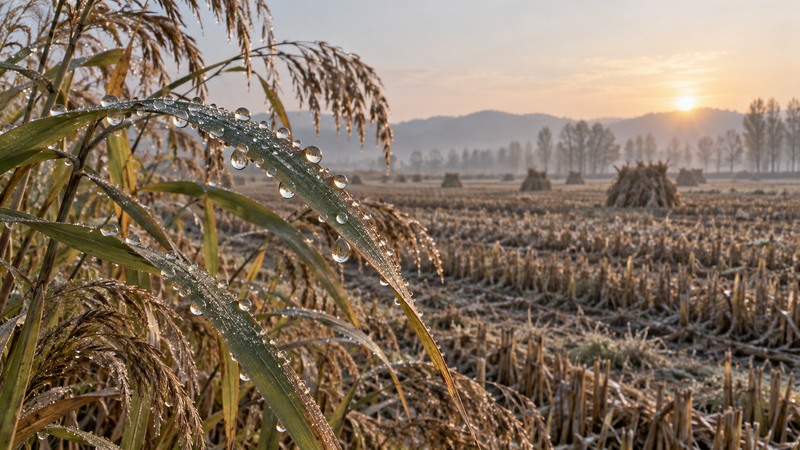
The 24 solar terms divide the sun’s annual motion into 24 named segments. UNESCO’s description notes that the system originated in the Yellow River reaches, was progressively applied nationwide, and became a framework for production and daily routines.
The traditional autumn sequence is:
- Beginning of Autumn (立秋, Lìqiū)
- End of Heat (处暑 / 處暑, Chǔshǔ)
- White Dew (白露, Báilù)
- Autumn Equinox (秋分, Qiūfēn)
- Cold Dew (寒露, Hánlù)
- Frost’s Descent (霜降, Shuāngjiàng)
Beginning of Autumn usually arrives in early August, well before September begins. That does not mean every Chinese city suddenly experiences cool weather. Solar-term names preserve a seasonal sequence and accumulated observations; they are not a national same-day temperature switch. The China Meteorological Administration explains that term names reflect temperature, precipitation, sunlight, phenology, and agricultural activity.
Use the 2026 solar terms calendar for dated boundaries and 24 solar terms by season for the traditional grouping.
China seasons by month
| Month | General meteorological season | What the label does not tell you |
|---|---|---|
| January | Winter | Southern coasts may be mild; northern and high-altitude areas can be much colder |
| February | Winter | Lunar New Year timing does not change the meteorological season |
| March | Spring | Northern warming and southern humidity do not begin together |
| April | Spring | Rain, fog, and rapid temperature changes vary by region |
| May | Spring | Southern China may already feel summery |
| June | Summer | Monsoon and rainy-season timing differs across regions |
| July | Summer | Heat, humidity, and plateau conditions remain very different |
| August | Summer | Beginning of Autumn is a solar term, while meteorological August is still summer |
| September | Autumn | Some southern areas remain hot; northern cooling becomes clearer |
| October | Autumn | Often strongly autumnal in the north, still warm in parts of the south |
| November | Autumn | Winterlike conditions may arrive early in the north and at elevation |
| December | Winter | Southern cities can stay mild despite the national calendar label |
This table answers “what season?” at a broad calendar level. It should not be used as a packing list without a city and forecast.
A practical way to check any date
Use four steps:
- Name the date and year. Solar-term and astronomical boundary times can shift slightly.
- Choose the system. For a month-based answer, use meteorological seasons. For cultural context, add the current solar term.
- Name the location. Province, city, elevation, and coastal or inland position matter.
- Check current conditions. A climate average cannot replace a short-range forecast or weather warning.
For example, “China is in autumn on October 14, 2026” is accurate as a calendar statement. “China will be cool and dry on October 14” is too broad because it turns a seasonal label into an unsupported nationwide forecast.
Frequently asked questions
Is October autumn in China?
Yes. October is autumn under the Northern Hemisphere meteorological calendar, and it lies between the September equinox and December solstice. Local weather can still feel warm in the subtropical south or winterlike at high elevation.
Is August autumn in the Chinese calendar?
Beginning of Autumn, the first solar term in the traditional autumn group, usually occurs in early August. Meteorologists still classify August as summer. The two answers use different systems.
Does all of China have four seasons?
Four calendar seasons are used nationally, but their local expression differs greatly. Some temperate regions have strong four-season contrasts, while subtropical, tropical, arid, or high-altitude locations follow different temperature and rainfall patterns.
Are the 24 solar terms the same as weather seasons?
No. They are a solar calendar and cultural knowledge system based on the sun’s annual motion and accumulated seasonal observations. They can provide context, but they do not guarantee the same weather across China on a given day.
What season should I use for a China trip plan?
Use the meteorological season for a broad month-based label, then check the destination’s climate and a current forecast. City, altitude, monsoon timing, and travel route matter more than the national label alone.