Quick answer
Winter in China is usually discussed as December through February, but that shorthand hides large regional differences. Northeast China can have deep snow and persistent subfreezing weather, while parts of southern China remain cool, damp, and green. For practical planning, choose the city first, then check its current forecast and warnings instead of treating China as one winter climate.
When is winter in China?
For a simple month-based answer, use December, January, and February. Astronomical winter begins at the December solstice and ends at the March equinox, while meteorological agencies may define seasons using temperature thresholds. These systems answer different questions, so their dates do not always match. The site’s guide to China’s seasons compares these calendar and climate definitions.
The Chinese solar-term calendar adds another layer. Beginning of Winter, Minor Snow, Major Snow, Winter Solstice, Minor Cold, and Major Cold mark six seasonal points in the sun’s annual motion. UNESCO explains that the system originated through observation in the Yellow River region and was later applied nationwide. It remains useful as a cultural and seasonal framework, but it is not a city-level weather forecast.
| Calendar lens | Useful answer | Main limitation |
|---|---|---|
| Common travel planning | December to February | Conditions differ sharply by region and elevation |
| Astronomical season | December solstice to March equinox | Describes Earth’s orbit, not local temperature |
| Six winter solar terms | Beginning of Winter through Major Cold | Traditional seasonal markers are not daily forecasts |
China has several very different winters
China extends across a vast range of latitude, altitude, and distance from the sea. A packing list that works in Harbin can be excessive in Guangzhou, while a mild daytime forecast in a highland city can still be followed by a cold night.
| Region | Typical winter character | What to check before travel |
|---|---|---|
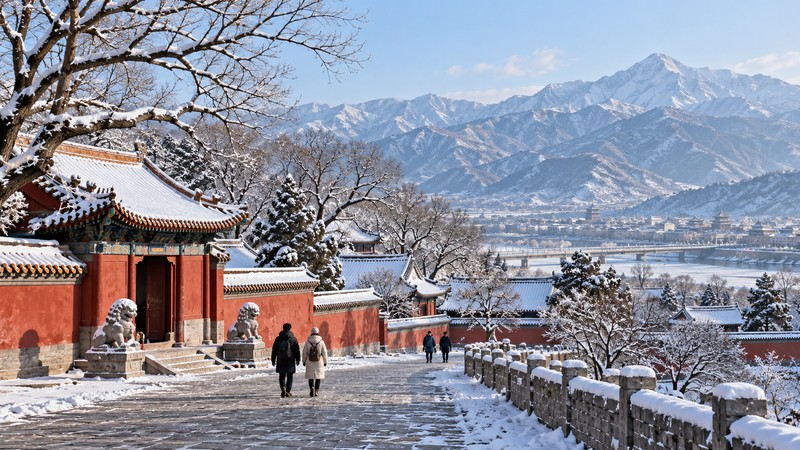
| Northeast, including Harbin | Long, very cold season; reliable ice and snow conditions are possible | Temperature, wind chill, snow, and short daylight |
| North China, including Beijing | Cold and often dry, with wind and occasional snow | Minimum temperature, wind, air quality, and heating-dried interiors |
| Lower Yangtze, including Shanghai | Cool to cold, often damp; snow is less dependable | Rain, humidity, cold snaps, and indoor heating arrangements |
| South China, including Guangzhou | Generally mild, with brief cold surges possible | Rain and sudden temperature drops |
| Southwest and highlands | Strong local differences caused by elevation and terrain | Day-night range, altitude, road conditions, and local warnings |
Northeast China: the clearest snow-season image
Northeast China supplies the familiar picture of frozen rivers, snow-covered streets, and outdoor ice activities. Harbin and other northern destinations actively develop winter tourism around these conditions. The useful planning lesson is narrower: snow tourism belongs to specific places and dates, not to the whole country.
North China: cold, dry, and often windy
Beijing and much of North China commonly experience cold, dry winter air. Sunshine can make a daytime walk feel manageable, yet shade, wind, and nighttime temperatures change the experience quickly. Layers, lip protection, and attention to wind forecasts are usually more useful than a single daily high.
The Yangtze region: damp cold matters
Shanghai, Nanjing, Hangzhou, and nearby areas often have a winter that feels different from the colder north. Temperatures may be higher, but moisture, cloud, rain, and building-heating differences can make the cold feel persistent. Travelers should check lodging details as carefully as the outdoor forecast.
South China: mild does not mean warm every day
Guangdong, Guangxi, Hainan, and neighboring areas generally have milder winters. This makes southern destinations attractive for winter trips, but strong cold surges can still produce abrupt drops. Carrying one light warm layer is safer than assuming tropical clothing will work for every day.
Western plateaus and mountains: elevation changes the answer
In Yunnan, Sichuan, Xizang, Xinjiang, and other western areas, altitude and terrain can matter as much as latitude. A sunny afternoon may be followed by a freezing night. Mountain roads can also have snow or ice even when a nearby basin is mild.
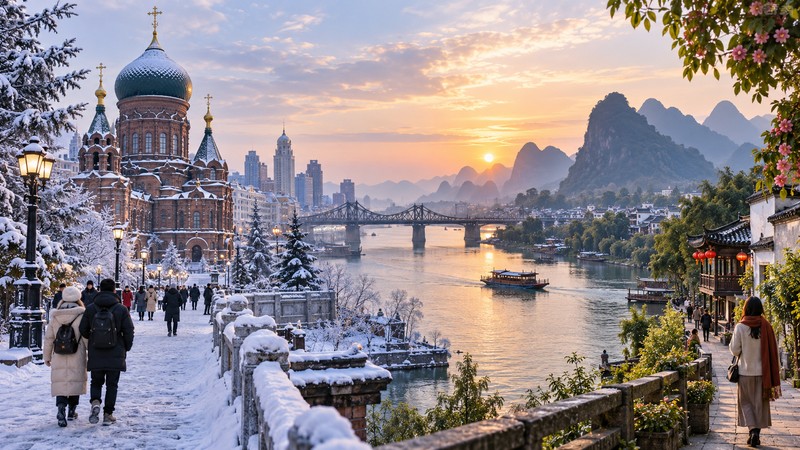
How winter relates to the 24 solar terms
The six winter terms provide a sequence for observing seasonal change. Beginning of Winter signals entry into the traditional winter section of the calendar. Minor Snow and Major Snow indicate increasing cold-season conditions, but their names do not guarantee snowfall at every location. Winter Solstice marks the shortest daylight period in the Northern Hemisphere. Minor Cold and Major Cold fall in the coldest part of the cycle.
| Solar term | Seasonal idea | Practical interpretation |
|---|---|---|
| Beginning of Winter | Traditional winter begins | Start watching local cold-season patterns |
| Minor Snow and Major Snow | Cold deepens | Snow is possible in suitable regions, not promised nationwide |
| Winter Solstice | Shortest-day turning point | Cultural observances and changing daylight |
| Minor Cold and Major Cold | Deep winter | Prepare for cold waves using current local information |
The sequence helps explain cultural timing. The winter solar terms guide covers the six terms in more detail. These markers should never be used alone to decide whether roads are safe, whether snow will fall, or what clothing a particular city requires.
Winter foods and customs vary by place
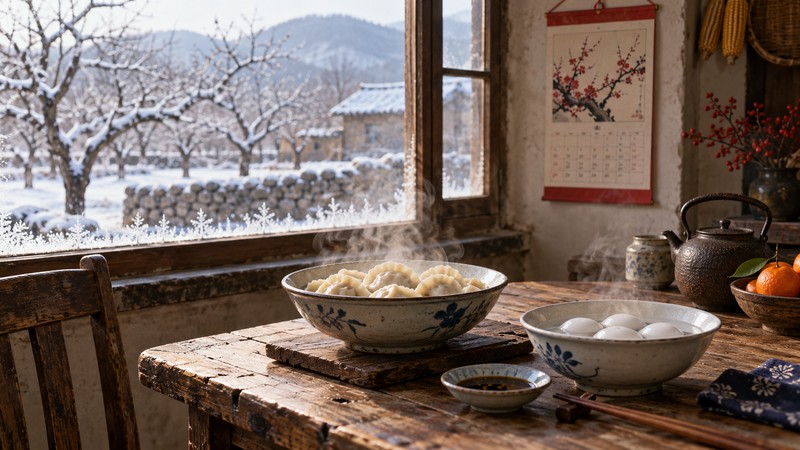
Winter food is often described through warming meals, preserved ingredients, communal hot pots, and festival dishes. Around the Winter Solstice, dumplings are strongly associated with parts of northern China, while tangyuan and other glutinous-rice foods appear in many southern traditions. These are broad patterns, not universal rules for every family.
The same caution applies to Lunar New Year timing. The festival can fall in late January or February, so it often overlaps with winter travel. Transport demand, closures, and family schedules can matter more to a visitor than a general climate description. Check the actual holiday calendar for the year of travel.
A practical winter planning checklist
Start with the exact city and travel dates. Then use an official local forecast close to departure, including warnings for snow, ice, wind, rain, or cold surges. Recheck transport conditions if your route includes mountains or rural roads.
Pack in layers. A base layer, insulating layer, and wind-resistant outer layer can be adjusted across indoor and outdoor settings. Waterproof footwear matters for snowmelt and cold rain. In dry northern areas, moisturizer and lip balm can be useful; in damp southern areas, quick-drying clothes may matter more.
Finally, confirm indoor conditions. Heating practices differ by region and building. Hotel descriptions, recent guest information, and direct confirmation can prevent a cold room from becoming the biggest surprise of the trip.
Questions about winter in China
What months are winter in China?
December through February is the simplest planning answer. Astronomical winter and traditional solar-term winter use different boundaries, and local climate can make winter conditions arrive earlier or later.
Does all of China get snow in winter?
No. Snow is common or dependable in some northern and high-altitude destinations, occasional in parts of central and eastern China, and rare in many southern lowland cities.
Is China colder than Europe in winter?
That comparison is too broad to be useful. Both China and Europe contain several climate zones. Compare specific cities, dates, wind, humidity, and elevation.
Is December a good time to visit China?
It can be. Northern destinations offer early winter scenery, while many southern destinations are mild. Check the exact city, daylight, holiday schedules, air connections, and weather warnings.
Are the winter solar terms fixed weather predictions?
No. They are calendar and cultural markers derived from the sun’s annual motion. Local weather can differ from the traditional seasonal description in any given year.