China does not have one national monsoon month. The East Asian summer monsoon influences much of the country from roughly May through September, but the main rain belt advances from south to north and behaves differently by region. South China can enter its first major rainy period in spring, the lower Yangtze usually sees Meiyu in early summer, and North China’s concentrated rainy season tends to arrive later.
For travel or fieldwork, use those ranges only as a planning frame. Check the destination’s local forecast and active warnings close to departure because onset, withdrawal, tropical cyclones, and extreme rainfall vary from year to year.
Quick answer
The broad monsoon season in China is often described as May to September. A more useful answer is regional: South China becomes wet earlier; the Jianghuai and lower Yangtze area commonly experiences Meiyu from early June to mid-July; the main rain belt then shifts north, bringing a shorter midsummer rainy season to North China. Southwest China also receives substantial summer-monsoon rain, while much of northwest China remains comparatively dry.
Quick reference: regional timing at a glance
| Region | Typical wetter period | Main feature | Planning limit |
|---|---|---|---|
| South China coast and inland south | Spring into early summer; another risk period in late summer | Pre-rainy-season fronts, summer monsoon moisture, and possible tropical-cyclone rain | Exact start and typhoon influence change each year |
| Jiangnan, Jianghuai, lower Yangtze | Often early June to mid-July | Meiyu front with persistent humid, cloudy, rainy spells | Some years are short, delayed, interrupted, or unusually intense |
| North China | Usually concentrated in midsummer, often after the Meiyu belt shifts north | Thunderstorms and shorter heavy-rain episodes | Rain can be localized and intense rather than continuous |
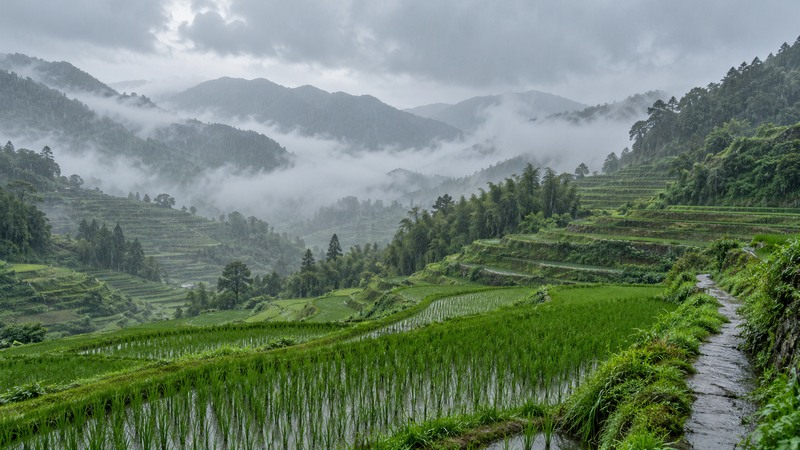
| Southwest China | Broadly late spring through summer | Moist southwest flow shaped by mountains and plateau terrain | Timing differs sharply between basins, plateaus, and valleys |
| Northwest China | No comparable uniform humid monsoon season | Drier continental climate; local mountain and convective rain | National monsoon summaries overstate rain for many western destinations |
These ranges describe climate patterns, not daily weather. A 2013 Acta Meteorologica Sinica study hosted by the China Meteorological Administration used May through September as a broad rainy-season frame and noted that regional rainy seasons progress from south to north.
What monsoon means in China
A monsoon is a seasonal change in large-scale winds, not simply a synonym for heavy rain. The Hong Kong Observatory explains the summer circulation through the different rates at which the Asian landmass and surrounding oceans heat. In the warm season, heated land helps draw moist air inland from the ocean. The Tibetan Plateau, the Himalayas, the western Pacific subtropical high, and moving weather systems all modify that basic pattern.
The winter monsoon reverses much of the flow: cold, dry continental air spreads south and east. That is why a phrase such as “China monsoon” can refer to both a wet summer circulation and a colder winter circulation. In travel questions, “monsoon season” usually means the summer rainy period.
China’s scale matters. Hainan, Guangdong, Shanghai, Beijing, Kunming, Xi’an, and Urumqi do not share one rainfall calendar. A national answer should therefore begin with the south-to-north progression and then narrow to the destination.
How the rain belt progresses
South China starts earlier
Spring and early summer bring increasingly warm, moist air to South China. Around the south coast, prevailing winds commonly turn more southwesterly between May and June. Frontal systems and monsoon moisture can produce repeated heavy-rain episodes before the main rain belt reaches the Yangtze region. Later in summer and early autumn, tropical cyclones can add a separate source of intense coastal rainfall.
That second period is one reason a single “rainy season ends in June” statement is misleading for Guangdong, Guangxi, Hainan, Fujian, and nearby coastal areas. A destination may have a break between different rain-producing patterns.
The Yangtze region has Meiyu
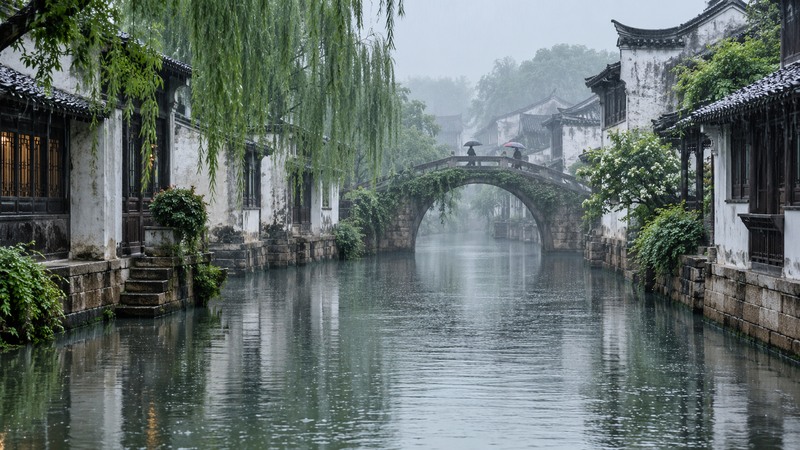
Meiyu is the best-known regional rainy season in eastern China. The China Meteorological Administration describes it as a product of the East Asian summer monsoon’s staged northward advance. It commonly affects the Jianghuai and lower Yangtze region from early June to mid-July, though official onset and withdrawal are diagnosed from actual weather rather than fixed calendar dates.
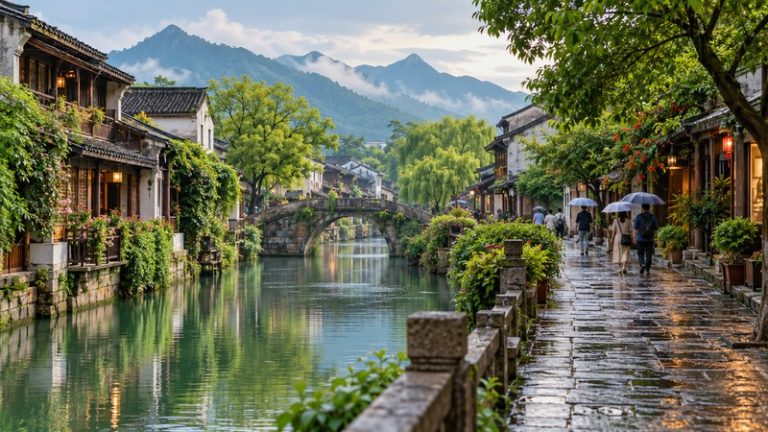
Meiyu weather often combines frequent rain, high humidity, cloud, limited sunshine, and weak surface winds. Shanghai, Jiangsu, Zhejiang, Anhui, Jiangxi, Hubei, and nearby areas may be affected, but the precise rain-band position changes during the season.
North China gets a shorter midsummer concentration
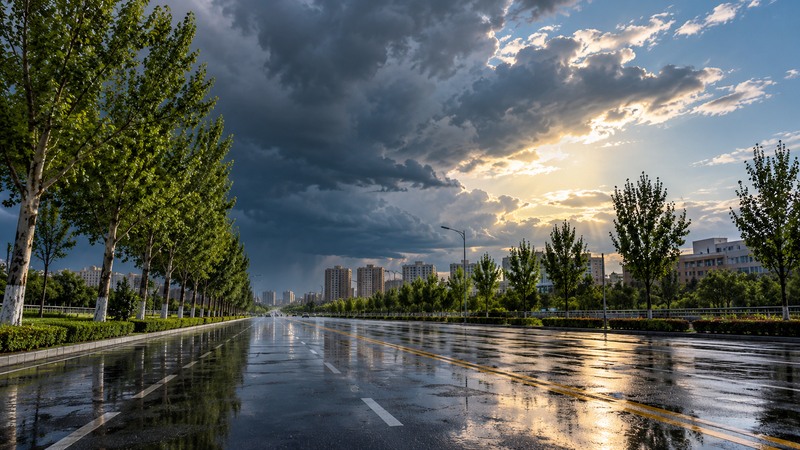
After the subtropical high and rain belt shift north, North China enters its main rainy-season phase. Beijing, Tianjin, Hebei, Shanxi, and neighboring areas often receive a large share of annual rain during a relatively short midsummer window. Rain may arrive through thunderstorms or organized heavy-rain systems rather than steady all-day drizzle.
For practical planning, “July and August” is a useful first check for North China, but it is not a promise that every day will be wet. Heat, dry intervals, severe convection, and localized downpours can occur within the same week.
How solar terms fit the rainy-season calendar
The 24 solar terms can help readers locate seasonal stages, but they do not forecast a particular storm. UNESCO describes the system as 24 segments of the sun’s annual motion, developed from seasonal and astronomical observation in the Yellow River reaches and later used widely as a framework for production and daily life.
| Solar-term marker | Approximate place in the Gregorian calendar | Rainy-season context |
|---|---|---|
| Grain in Ear | Around June 5–6 | Often near the developing Meiyu period in parts of eastern China |
| Summer Solstice | Around June 21 | Falls within early-summer monsoon activity and many regional rainy periods |
| Minor Heat | Around July 6–8 | Often near late Meiyu or the transition as the rain belt moves north |
The dates shift slightly by year, and the same term can coincide with different weather in different provinces. Use the terms as calendar and cultural anchors. Use meteorological observations and forecasts for decisions about rain, flooding, heat, or travel.
The broader China season guide explains the difference between calendar seasons, climate seasons, and the solar-term system.
Travel planning by destination
Start with the city and province rather than the country name. For Guangzhou or Shenzhen, check spring and early-summer heavy-rain risk plus later tropical-cyclone forecasts. For Shanghai, Hangzhou, Nanjing, or Suzhou, check whether the Meiyu front is active. For Beijing or Tianjin, pay particular attention to midsummer thunderstorm and short-duration heavy-rain warnings. For Yunnan, Sichuan, or Chongqing, terrain and elevation make local forecasts essential.
Pack for humidity as well as rain. A compact umbrella helps in light rain, but a breathable rain shell, quick-drying shoes, and a waterproof pouch are more useful during wind or repeated showers. Keep medicines and documents in sealed bags. Do not enter flooded underpasses, river channels, mountain gullies, or closed scenic areas.
Check forecasts again on the day of travel. Climate averages can help choose a month, but they cannot identify a specific safe travel window. Use the China Meteorological Administration, the National Meteorological Center, or the destination’s official meteorological service for live alerts.
Monsoon, Meiyu, rainy season, and typhoon are not the same
| Term | What it describes | What it does not mean |
|---|---|---|
| Summer monsoon | Large-scale seasonal circulation carrying warm, moist air into East Asia | Rain at the same time everywhere |
| Rainy season | A region’s climatological period of concentrated rainfall | A fixed start and end date every year |
| Meiyu | A specific early-summer rain-band regime in the Jianghuai and lower Yangtze area and wider East Asia | Every kind of summer rain in China |
| Tropical cyclone | An organized storm over warm ocean waters that may bring coastal wind and rain | The monsoon itself |
A tropical cyclone can interact with monsoon flow, and monsoon moisture can feed heavy rain, but the terms remain distinct. Keeping them separate makes forecasts easier to understand and prevents a coastal typhoon warning from being treated as a national monsoon forecast.
Frequently asked questions
Does all of China have a monsoon season?
No single monsoon season describes every part of China equally. Eastern and southern regions are strongly affected by East Asian summer-monsoon rainfall, southwest China has its own terrain-shaped wet-season patterns, and much of northwest China is considerably drier.
What are the rainiest months in Beijing?
Beijing’s rainfall is concentrated in summer, with July and August commonly the first months to check. Individual years and storms vary, so use current local forecasts for travel or outdoor work.
When is the Meiyu season around Shanghai?
The typical planning range is early June to mid-July. Official meteorological agencies determine each year’s onset and withdrawal from observed conditions, so the actual period may begin earlier or later and may include breaks.
Does monsoon season mean it rains every day?
No. A monsoon season can include dry intervals, heat, scattered thunderstorms, persistent frontal rain, and short intense downpours. The mix depends on region and the position of major weather systems.
Are solar terms weather forecasts?
No. Solar terms are calendar and cultural markers based on the sun’s annual motion. They provide a useful seasonal framework, but they cannot replace a local weather forecast or hazard warning.